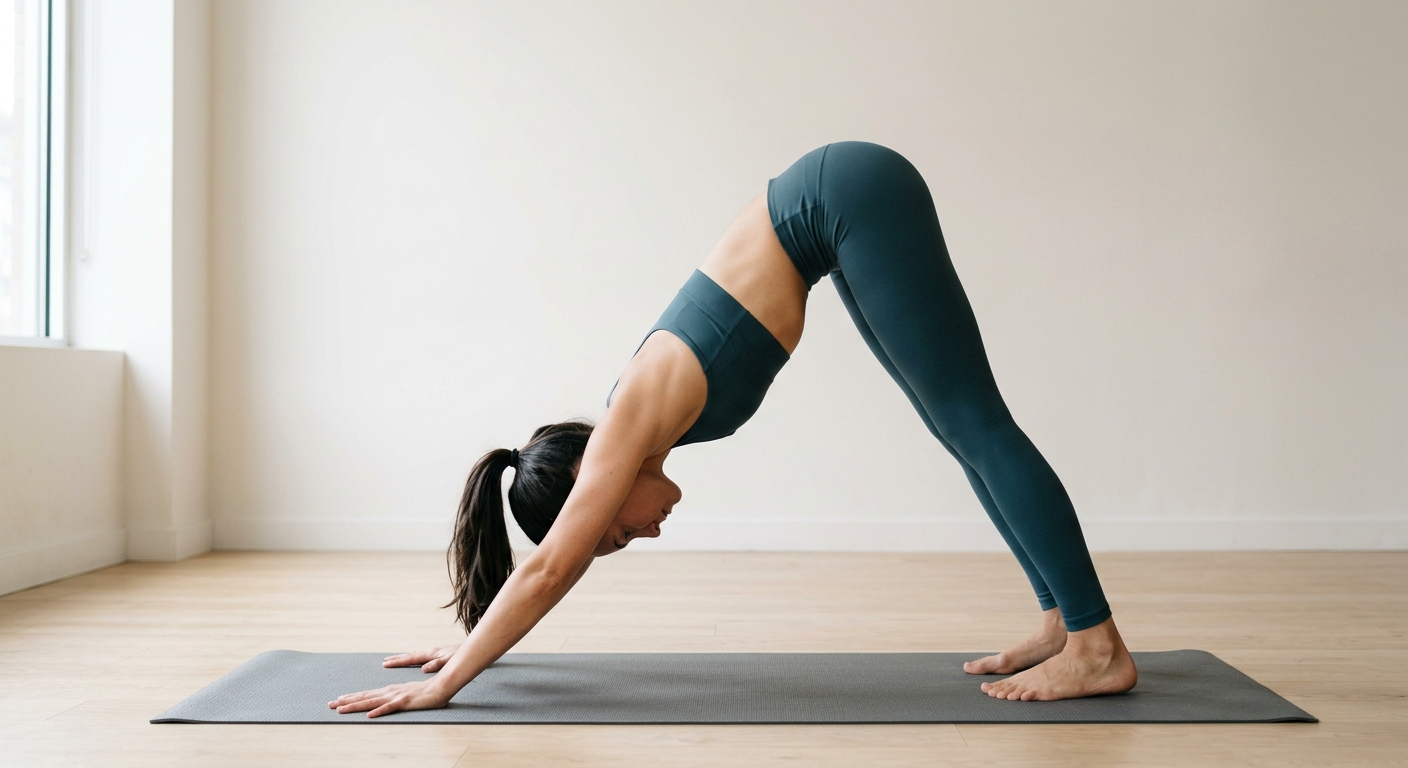
Child's Pose
Balasana
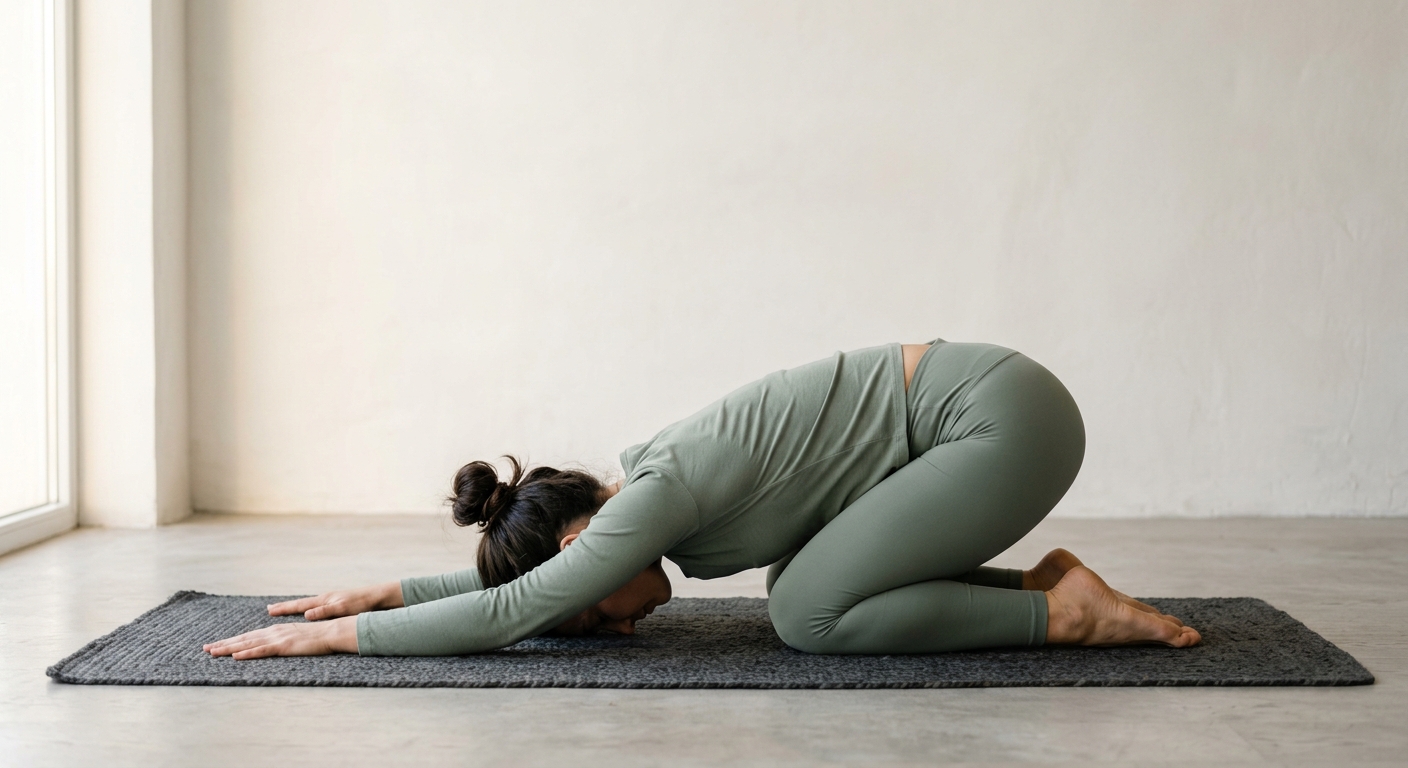
How to Practise It
- 1Begin on your hands and knees in a tabletop position with wrists under your shoulders and knees under your hips.
- 2Bring your big toes together to touch, and widen your knees hip-distance apart or out toward the edges of your mat.
- 3On an exhale, press your hips back toward your heels and drape your torso down between or over your thighs.
- 4Walk your arms straight out ahead of you with palms flat, or drape your arms alongside your legs with palms facing upward.
- 5Rest your forehead completely on the mat, relaxing your jaw, eyebrows, and neck muscles.
- 6Soften your shoulder blades away from your ears, allowing your armpits and chest to melt downward.
- 7Hold the posture for 5 to 10 slow, deep breaths, expanding the back of your lungs with every inhale.
Child's Pose (Balasana) is a foundational, kneeling resting posture in yoga where the practitioner folds the torso forward over or between the thighs, brings the hips toward the heels, and rests the forehead on the floor with arms either extended forward or relaxed alongside the body. It gently decompresses the spine, releases the hips and ankles, and activates the parasympathetic nervous system for instant physical and mental grounding.
In my daily online classes, I often see students treat Balasana as merely a passive 'break' between challenging vinyasas. But when approached with intention, this posture is one of the most powerful diagnostic tools in your practice. It is where you check in with your breath quality, notice whether your lower back is holding gripping tension, and feel the exact mobility available in your hips and ankles on that particular day.
How Child's Pose Should Feel
When you settle into Child's Pose, you should feel a quiet, spreading stretch across the entire posterior chain—from the base of your skull, down between your shoulder blades, into the lumbar spine, and through the glutes. Because your abdomen is gently compressed against or framed by your thighs, your breath has nowhere to go in the front body. This naturally forces your inhalation into the back and lateral ribs.
I always cue my students to visualize their breath inflating the kidney area and expanding the space between the lower ribs on every 4-count inhale. On each 5- or 6-count exhale, you should feel your pelvis become heavier, sinking closer to your heels without forcing down. The forehead resting against the mat creates a mild vagal stimulation that tells your nervous system: you are safe, you can down-regulate now.
Common Alignment Mistakes I See in Live Classes
Because I teach via live video with small groups, I spot the same three recurring issues in Child's Pose week after week:
- The Floating Head Syndrome: When students with tight hips or thoracic spines fold forward, their hips pull their torso back, leaving their head dangling an inch or two above the mat. This immediately creates isometric tension in the neck and upper trapezius. If your forehead does not touch down with ease, never strain to reach it. Bring the floor to you by sliding a foam block, a bolster, or even your stacked fists directly under your brow.
- Aggressive Shoulder Reaching: In the extended version (Utthita Balasana), students often reach their fingers so aggressively forward that their shoulder blades creep up into their earlobes, locking up the neck. I constantly remind my students: walk your hands forward to find length, but then actively soften the tops of the shoulders away from your ears and let your elbows rest lightly on the mat if active reaching causes tension.
- Ignoring Ankle and Knee Pinching: If you have stiff ankles or sensitive knee joints, sitting straight back can cause sharp compression across the tops of the feet or inside the knee crease. I tell my students immediately: sharp pain is your body's stop sign. Never try to push through knee joint discomfort. A simple rolled blanket tucked tightly behind the knee crease before sitting back opens up the joint space and provides instant relief.
Customizing the Pose for Your Body
There is no single correct footprint for Child's Pose. In my beginners' and mobility sessions, I teach two main structural variations:
- Wide-Knee Child's Pose (Utthita Balasana): Bring your big toes together and take your knees wide to the outer edges of your mat. This version creates ample room for your belly and ribcage to descend, focusing the stretch into the adductors (inner thighs) and groin while relieving pressure on the digestive organs. * Classic Closed-Knee Child's Pose: Keep your thighs parallel and pressed together, resting your chest directly on top of your thighs with arms swept back by your ankles, palms facing up. This variation gives a much deeper stretch to the lumbar spine and creates maximum back-body breath feedback.
If you have an existing knee, ankle, or hip injury, please consult your healthcare provider or physical therapist before practicing deep flexion postures. In the meantime, remember that Child's Pose is always available to you at any point in your practice. You do not need my permission—or any teacher's permission—to drop to your knees and find Balasana whenever your heart rate spikes or your breath becomes ragged.
If you would like direct, real-time feedback on your alignment and modifications tailored specifically to your body, join me on the mat in my live online yoga classes this week.
Benefits
- • Gently lengthens the lumbar spine and decompresses the lower back.
- • Releases tension across the hips, glutes, thighs, and ankles.
- • Down-regulates the sympathetic nervous system, lowering heart rate and stress levels.
- • Encourages deep diaphragmatic breathing into the posterior and lateral ribcage.
- • Provides an accessible, grounding physical reset during dynamic yoga sequences.
Modifications
- • Place a folded blanket behind your knee creases to reduce acute knee flexion angle.
- • Rest your forehead on a yoga block or stacked fists if your head does not easily reach the floor.
- • Place a rolled towel under the tops of your ankles if your feet cramp or cannot flatten comfortably.
- • Widen your knees to mat-width and rest your torso on a bolster for a fully supported restorative setup.
Muscles Worked
When to Avoid or Modify
- • Recent or chronic knee injuries involving pain during deep flexion.
- • Third-trimester pregnancy without wide-knee modification to avoid abdominal compression.
- • Acute ankle inflammation or severe plantar flexor tendonitis.
- • Shoulder impingement (avoid extended arms overhead; use the arms-back variation instead).
This is general guidance, not medical advice. If you have an existing injury or condition, check with your doctor before practising.